
Black peppercorns can look very similar online, yet their quality can differ significantly. Two packets may both claim to contain premium whole black pepper, but one may open with a clean, lively aroma while the other smells faint, contains hollow berries or leaves broken pieces at the bottom.
The problem is not that shoppers cannot recognise quality. It is that many online listings show only a close-up photograph and familiar words such as bold, aromatic, handpicked and export quality.
To choose premium black peppercorns well, look at colour, berry development, density, aroma, moisture condition, cleanliness, packaging and traceable origin together. These quality signals help separate well-developed black peppercorns from weaker or poorly handled lots.
What Should Premium Black Peppercorns Look Like?
Premium whole black pepper should contain mostly mature, well-developed berries with a naturally wrinkled surface, reasonably consistent size and a brownish-black to dark-black appearance.
The peppercorns should feel dry and substantial rather than soft, unusually light or hollow. When freshly crushed, they should release a sharp, warm and penetrating pepper aroma without musty, damp or stale notes.
Idukki buyer’s rule: “Premium” becomes meaningful only when the seller supports it with origin, batch, grading, packing and freshness information.
How to Identify Quality Black Peppercorns
A good purchase of black peppercorns is not decided by one sign. The most reliable reading comes from several signals working together: how the berry looks, how it feels, how it smells and how honestly the seller describes it.
Use this compass before trusting an online listing that relies only on dark colour or the word bold.
Natural colour
Look for brownish-black to dark-black berries with natural variation, not artificial-looking sameness.
Bold but filled
A large berry should also feel mature, firm and substantial for its size.
Crush, smell, then trust
A premium peppercorn should prove itself when cracked. The aroma should rise quickly and feel warm, sharp and clean.
Dry and free-flowing
Avoid pepper that feels damp, clumps together or smells earthy and musty.
Traceable origin
Good listings state the sourcing region, batch details and how the pepper is protected after packing.
Buying truth: The darkest berry is not automatically the best berry. The best pepper keeps its story consistent from origin to the grinder.
What Makes Black Peppercorns Premium?
“Premium” is a commercial description, not a complete quality specification for black peppercorns. Food standards set minimum requirements, while a genuinely premium selection should perform better in the areas a customer experiences: aroma, cleanliness, maturity, consistency and freshness.
Spices Board India identifies black pepper as the dried mature berry of Piper nigrum. For a customer, the practical question is whether the berries look mature, smell lively and arrive in a condition that protects aroma.
Black Peppercorns Quality Checklist at a Glance
A good online listing should help you inspect black peppercorns before you pay. The table below gives a practical way to judge pepper quality without relying on one dramatic photograph.
| Quality Marker | What to Look For | What Should Make You Cautious |
|---|---|---|
| Colour | Natural brownish-black to black berries | Visible mould, excessive dust or unexplained colour claims |
| Boldness | Round, mature-looking and well-filled corns | Large berries that feel hollow or unusually light |
| Aroma | Immediate warm and penetrating aroma when crushed | Flat, dusty, stale, musty or rancid smell |
| Moisture | Dry, free-flowing peppercorns | Clumping, softness, condensation or damp odour |
| Traceability | State, district or sourcing region clearly stated | Vague phrases such as “Indian premium pepper” only |
How to Judge the Colour of Black Peppercorns
Good black pepper is not polished jewellery. Whole berries naturally vary between deep brown, brownish-black and black, especially across farms, varieties, harvest lots and drying conditions.
Online photos can also be misleading. Strong lighting, editing and dark backgrounds can make pepper look richer than it may appear in the kitchen.
Better reading: A seller who explains source, grading and batch condition gives you more useful information than one relying only on a dramatic product photo.
What Does “Bold” Mean in Black Peppercorns?
Boldness generally refers to the size and development of the peppercorn. Larger, rounder berries create a premium appearance and are often preferred for high-quality whole-pepper packs.
External size should never be separated from density. A large berry that is poorly developed inside may contribute less aroma and flavour than a slightly smaller but mature, well-filled corn.
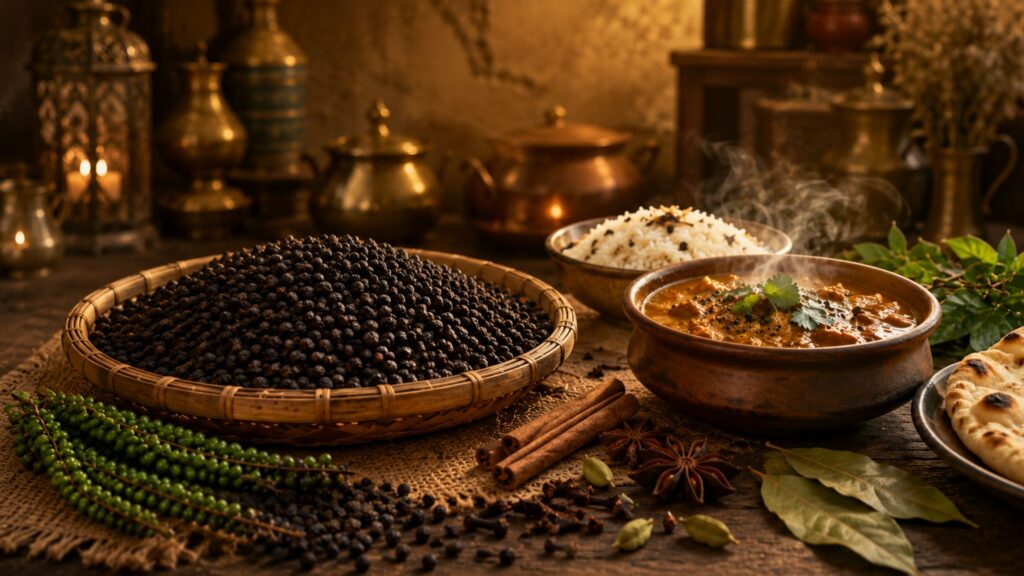
Where premium pepper value is created
Premium pepper value is not created only at the retail shelf. It begins with farm maturity, continues through drying and cleaning, and becomes visible when the customer opens the pack.
This demand map helps separate origin value, trade value, retail value and kitchen value without treating every “Kerala pepper” listing as the same product.
Regional value canvas
Idukki source story
Pepper grown in a mixed spice landscape gains value when the batch is honestly identified and handled well.
Kerala heritage
Kerala carries deep pepper history, but present quality must still be judged batch by batch.
Cleaned and graded lots
Garbling, grading and sorting add value by removing unwanted material and weak berries.
Aroma after crushing
The final proof is the warmth and sharpness released when the peppercorn is cracked.
Demand attention zones
Online shoppers: need visible proof, batch clarity and seller transparency before trusting premium claims.
Daily cooks: want strong aroma, clean berries and pack sizes that stay fresh after opening.
Gift buyers: value bold, uniform whole peppercorns with a clear origin story.
B2B buyers: should ask for density, cleaning status, moisture control and lot-level records.
Strategy note: Premium pepper should be sold through clarity, not only through dark colour and high-contrast product photos.
Density reveals what the photograph cannot
Density is one of the most important and least discussed markers of whole black pepper quality. Developed peppercorns tend to feel heavier and more substantial than immature or hollow berries.
FSSAI’s standards for whole black pepper include bulk density, light berries and pinheads among the quality parameters. For larger B2B purchases, ask the supplier for the lot’s litre weight or bulk-density specification.
You can review the official FSSAI spice standards document for whole black pepper quality context.
Use aroma as the final kitchen test
The simplest useful test happens after delivery. Take three or four peppercorns and crush them immediately before smelling.
Fresh whole pepper should release an assertive aroma quickly — warm, woody, sharp and lively — with a clean heat that becomes more noticeable when the pepper is ground.
Kitchen proof: Pepper bought for aroma should not smell flat before it reaches the pan.
Moisture can protect or ruin the batch
Pepper must be dried adequately before storage, but that does not mean it should be brittle, dusty or stripped of aroma. Too much retained moisture is the bigger risk because the berries may soften, develop musty notes, attract infestation or become vulnerable to fungal growth.
FSSAI sets a maximum moisture level for whole black pepper, while good storage practice often aims for drier, more stable pepper before packing. At home, warning signs include clumping, softness, condensation inside the pack or an earthy musty smell.
Check for pinheads, light berries and excessive breakage
Turn the unopened pack gently and look at the bottom. A small amount of natural dust or occasional breakage can occur during transport, but a premium whole-pepper pack should not be dominated by fragments, tiny undeveloped berries or powder.
Pinheads are especially useful to recognise. They are very small underdeveloped berries with less odour and flavour than normal pepper berries. A few may occur naturally; a large proportion weakens the value of a supposedly premium selection.
Inspection cue: A premium whole-pepper pack should look like peppercorns, not pepper sweepings.
Read the packaging before reading the claims
Whole pepper keeps aroma better than pre-ground pepper because the berry protects aromatic compounds until grinding. That advantage weakens when pepper is packed in a thin, poorly sealed pouch and repeatedly exposed to air, humidity, heat and light.
Look for a properly sealed food-grade pack with a moisture-resistant barrier, clear net quantity, packed-on or manufacturing date, best-before information and batch or lot number. A resealable closure is useful after opening, but it does not replace a good original barrier seal.
Ask traceability questions before buying online
Origin should be more precise than “sourced from India.” A good seller should be able to state at least the producing state or sourcing region and connect that information to a batch record.
Traceability does not require publishing a farmer’s private details. It requires the business to maintain enough batch-level information to explain where the pepper came from and how it moved through cleaning, grading, packing and dispatch.
| Buyer Question | What a Reliable Seller Should Explain |
|---|---|
| Which state or district does this batch come from? | A clear sourcing region, not only a broad India or Kerala label. |
| Is the pepper cleaned, garbled or size-graded? | The handling process used before packing. |
| Does the seller assess light berries, pinheads or density? | How weak, underdeveloped or unwanted material is reduced. |
| When was the pepper packed? | Packed-on date, batch number and best-before details. |
| How is moisture controlled? | Storage and packaging practices that protect aroma after packing. |
Why Kerala remains important to India’s pepper story
Kerala’s relationship with black pepper is older than online marketplaces and modern packaging. Pepper has shaped the food culture and trading history of the Malabar region, while the humid Western Ghats landscape remains closely associated with pepper cultivation.
It is also important to describe the present market honestly. Kerala remains a major and culturally important pepper origin, but quality should be judged batch by batch through maturity, drying, cleaning, density, storage and freshness.
For production context, the Kerala Economic Review reports Kerala pepper area and production for 2024–25, while official spices statistics also show the changing role of other producing states. View Kerala Economic Review.
The Idukki angle: highland cultivation and a working spice economy
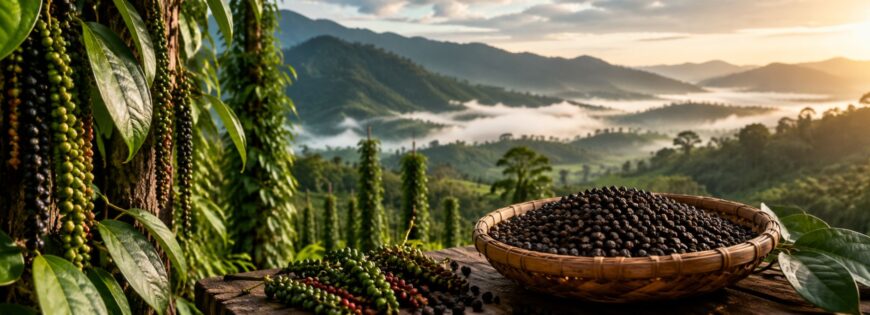
In Idukki, pepper grows within a living highland farming system rather than as an isolated product. Vines are commonly seen climbing support trees alongside cardamom, coffee, nutmeg, clove and other crops across sloping farms.
Idukki’s relevance also extends beyond the farm. The Spices Board’s Puttady Spice Park in the district is connected with small cardamom and pepper processing infrastructure, reinforcing Idukki’s role as a spice-producing and trading region. Visit Spices Board India.
Origin rule: An Idukki-origin batch should be identified as such. Pepper sourced from another producing region should carry its correct origin.
Is all Kerala pepper “Malabar Pepper”?
No. Malabar Pepper is a registered geographical indication, and the official GI record identifies its geographical area across Kerala, Karnataka and Tamil Nadu.
A pepper pack should not use GI terminology merely because the berries came from Kerala or because “Malabar” sounds premium. GI use should be supported by applicable origin, specification and authorised-user requirements.
For official context, see the GI Registry record for Malabar Pepper.
What the current pepper market tells buyers
Black pepper remains a commercially significant Indian spice, and market prices can move with supply, quality, demand and trade conditions. A local market quote should not be treated as the expected retail price of a cleaned, graded and consumer-packed product.
Retail pricing also absorbs sorting loss, packaging, fulfilment, taxes, marketplace charges and the cost of maintaining the product correctly before sale.
Buyers can check dated references on the Spices Board current market price page, but the final buying decision should still include aroma, cleanliness, pack quality and traceability.
Whole peppercorns or pepper powder: which should you buy?
Choose whole black peppercorns when aroma matters. Grind or crush only the quantity needed for the meal because whole pepper lets you inspect the berries and control the grind.
Powder may be convenient for high-volume cooking, but once pepper is ground, more surface area is exposed to air and aroma fades faster. For most home kitchens, a smaller pack of fresher whole pepper is better than a large pack stored open for months.
Kitchen answer: Buy whole pepper for visibility and aroma. Buy powder only when speed and even mixing matter more than fresh grinding.
The premium pepper memory wheel
A customer may first buy pepper because the listing looks trustworthy. Repeat purchase happens only when the pepper performs after the pack is opened.
For Idukki Spices & Herbs, this is the elegant growth path: visible quality, honest origin, clean aroma, better cooking and a customer who remembers the difference.
The listing feels clear
Origin, form, batch and pack details reduce doubt before the first purchase.
The berries look mature
The customer sees clean, whole, developed peppercorns instead of dust and fragments.
The aroma arrives
A few cracked corns release warmth, sharpness and a clean pepper character.
The dish gains depth
Pepper supports rasam, soups, eggs, curries, marinades and finishing.
The kitchen notices
Aroma makes the product memorable beyond price and packaging.
The next order feels safer
When the first pack proves itself, repeat buying becomes natural.
Growth truth: Premium pepper earns repeat trust when the aroma proves the story.
Red flags in an online black pepper listing
Be cautious when the seller repeatedly uses words such as export quality, world’s best, medicinal, chemical-free or organic without providing the corresponding specification, certification or evidence.
Other warning signs include no origin beyond India, no packed-on date, no batch number, a photo that hides the bottom of the pack, excessive focus on darkness of colour and no explanation of cleaning or grading.
Buyer reminder: Unsupported claims are not substitutes for batch information.
Final buying checklist before you order
The best purchase is not necessarily the darkest berry, the largest berry or the most expensive packet. It is the product whose quality story remains consistent from origin to grading, from grading to packaging, and from the unopened pack to the first peppercorn you crush.
- Confirm that it is whole black pepper, not powder or a mixed pepper product.
- Check whether the seller gives state, district or sourcing-region information.
- Look for cleaning, garbling, grading or selection details.
- Inspect the pack for visible dust, fragments, pinheads and hollow berries.
- Check batch number, packed-on date and packaging protection.
- Crush a few peppercorns after delivery and judge the aroma.
The final word
Buying premium black peppercorns online should not require blind trust. Begin with what the seller can show: origin, batch information, grading, berry condition, packing date and protective packaging.
Then confirm the quality in your own kitchen by examining the corns and crushing a few. A peppercorn carries more than heat. It carries the maturity of the berry, the conditions of the farm, the discipline of drying and the care taken during storage.
Choose the pack that explains that journey honestly — and still proves itself when the grinder turns.
Frequently Asked Questions
How can I identify premium black peppercorns?
Look for mature, well-developed and reasonably uniform peppercorns with natural brownish-black to black colour. They should feel dry and substantial and release a strong, clean pepper aroma when freshly crushed.
Is bold black pepper always better?
Not always. Bold peppercorns offer a premium appearance, but size alone does not guarantee density, aroma or maturity.
What is bulk density in black pepper?
Bulk density is the weight of a defined volume of pepper. It helps indicate how well-developed and substantial the berries are as a lot.
What colour should good black pepper be?
Good whole black pepper may naturally range from brownish and dark brownish to blackish. Perfectly uniform jet-black colour is not required.
How do I know whether black pepper contains too much moisture?
Look for clumping, softness, condensation, visible mould or a musty smell. Precise moisture content requires testing.
Is Kerala black pepper better than pepper from other states?
Kerala has a deep pepper-growing and trading heritage, but quality must be judged batch by batch. Origin matters, but maturity, drying, cleaning, density, storage and freshness matter just as much.
Is Idukki black pepper the same as Malabar Pepper?
Not automatically. Idukki is a pepper-growing district in Kerala, while Malabar Pepper is a registered geographical indication governed by defined requirements.
Why should I buy whole pepper instead of pepper powder?
Whole pepper lets you inspect the berries and grind only what you need. Fresh crushing releases aroma at the point of use and gives greater control over texture.
Choose whole black pepper with a clearer origin and a fuller story.
Explore black pepper selected with attention to berry development, aroma, cleanliness, traceability and the way it will finally be used in your kitchen.